
Riding the Rails from Kunming to Vientiane: A Ten-Hour Journey Across Worlds
My journey south began in the mid-morning, with a long taxi ride through Kunming toward Kunming South Railway Station. The city slid past the window in a familiar blur of overpasses and apartment blocks, but my mind was already ahead: crossing borders by rail, threading through mountains, and watching two countries slowly change outside a train window.
Knowing that meal options on long-distance trains can be unpredictable, I planned ahead. I ate a heavy breakfast at the hotel, just in case there was little or nothing available onboard. Experience has taught me that when traveling internationally by train, food is never guaranteed.
I arrived about forty minutes early and stepped into the ritual of modern Chinese rail travel. Passport checked, ticket verified, bags through security. Efficient, calm, predictable. Because this was an international train, a small knot of uncertainty lingered. I stopped by the information kiosk, where a staff member checked my passport and handed me a slim slip of paper with a barcode. That unassuming piece of paper would quietly become essential, checked repeatedly throughout the journey.
Kunming South Station is grand in that unmistakably Chinese way: airport-style curbside drop-offs, massive entry gates, multiple security lanes, and a vast central concourse acting as the station’s spine. Light floods in through tall windows, ceilings soar overhead, and seating is plentiful. Crowd management here isn’t accidental; it’s architectural.
About twenty minutes before departure, movement subtly shifted. Lines began forming at the platform access gates. One detail stood out: one of the outer lanes is typically reserved for passengers without a local Chinese ID, allowing for a final manual passport check. Even this felt routine, built into the system rather than tacked on as an afterthought.
Everything moved smoothly, mostly. A few uncles and aunties tested the boundaries of order, pushing and hovering where they shouldn’t. It was mildly irritating, but the system absorbed it without spiraling into chaos.
Down on the platform level, coach numbers were clearly marked. Officials stood at each gate, managing boarding with quiet authority. The train arrived and stopped exactly where the markings indicated. Doors opened. Passengers boarded. And we were off.
The train itself was striking: green with red, blue, and black stripes, a livery created specifically for the China–Laos international service. This wasn’t just another train; it felt like a rolling symbol of connectivity. The Kunming–Vientiane international service uses a specially configured CR200J “Fuxing” Electric Multiple Unit (EMU) built by CRRC for cross-border operation.
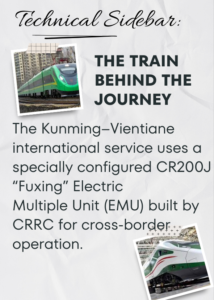
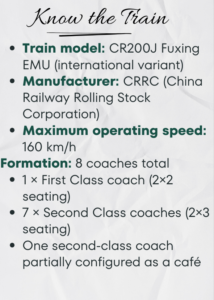
Inside, there were two classes: first class in a 2×2 layout and second class in a denser 2×3. I had booked first class through 12Go Asia, specifically requesting a window seat, imagining comfort and uninterrupted views.
Reality, of course, had other ideas. My assigned seat technically had a window, but it faced the wrong direction and was aligned with a misaligned panel rather than with open glass. A window seat in name only. A double disappointment.
I found the attendant, who spoke no English, and pleaded my case through Google Translate, explaining that I was a tourist and mildly devastated. She smiled, surveyed the mostly empty coach, and told me to take any open seat. Minutes later, I was settled into a wide, perfectly aligned window seat, the kind you hope for on a journey like this. She even returned later to confirm the seat would remain free until Vientiane. A small kindness that stayed with me.
As the train accelerated smoothly to its maximum speed of 160 km/h, the scenery opened up: steppe farmland clinging to mountain slopes, rolling hills patterned with greenhouses, and distant ridgelines fading into haze.
Inside, the train was tastefully designed. Floral patterns adorned the headrest covers. A small vase sat on tables between facing seats. A flower heart decorated the entrance to the first-class coach. Everything was spotless. The crew looked sharp and professional. Subtle elegance, not excess.
I quickly realized I was likely the only brown guy on board. Tourists were fewer than expected. Most passengers appeared to be Chinese travelers heading into Laos. Only later, during immigration, would I discover a large tour group traveling together.
Outside, the railway itself took center stage. The China–Laos Railway cuts through some of the most unforgiving terrain in the region. Tunnels and viaducts dominate the route. Long stretches underground are punctuated by brief flashes of daylight, just enough time to glimpse a gorge, a river, or a village perched on a mountainside before plunging back into darkness.
At one point, I counted three trains passing in the opposite direction while we were still inside the same tunnel. Without this railway, this journey would take many more hours. Watching it all unfold felt like witnessing engineering ambition made real.
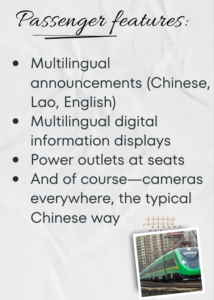
Announcements were made in Chinese, Lao, and English. A rolling digital display showed speed, next stops, and gentle reminders in all three languages. Simple, functional. Beyond Kunming, spoken English was virtually nonexistent.
The eight-coach consist included one first-class coach and seven fully packed second-class coaches, with part of Coach 4 converted into a café. I eventually went for lunch and found a perfectly acceptable chicken rice with a drink. Pre-cooked and reheated, nothing memorable, but enough to validate that heavy breakfast as good planning rather than paranoia.
We arrived at Mohan, the final station in China, exactly on time. Everyone disembarked for immigration. The process took about forty-five minutes and was mostly smooth, though the large tour group injected noise and confusion into the queues. Still, Chinese border staff managed the crowds efficiently and got everyone back on board without delay.
The border itself passed unseen, hidden inside a tunnel beneath the mountains. When we emerged, we were in Boten, Laos.
The contrast at the Lao border was immediate. Immigration here was less organized, less technical, and more manual than on the Chinese side. It worked, but just barely, and took longer than expected. Combined, both border checks stretched to a little over two hours.
Then came the most striking transition of the day.
As we pulled away from Boten, the difference between the two countries was unmistakable. Infrastructure, housing, vehicles, everything shifted abruptly. It felt like crossing from the United States into Mexico. In China, I had phone signal even in the deepest, longest tunnels. In Laos, signals appeared briefly near towns, then vanished again into the mountains.
The scenery remained beautiful: farmland, ravines, forests, and peaks. After Boten, only three stops remained: Muang Xay, Luang Prabang, and Van Vieng. I had heard that Laos was a backpacker’s paradise, but it truly became clear at Luang Prabang and Van Vieng. Backpackers boarded in noticeable numbers, sunburned, relaxed, and carrying that unmistakable long-term-travel energy. Places to return to, I thought. With family. With friends.
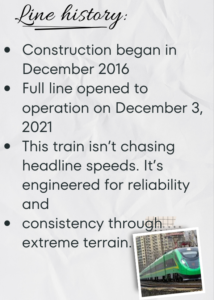
As we left Muang Xay, the sun sank low, painting the mountains in deep reds and oranges. The train kept threading through tunnels and across viaducts at a steady 160 km/h, seemingly unfazed by the terrain.
Every station was on time. No delays. No unscheduled stops.
By Van Vieng, darkness had fully settled. I drifted into a brief nap before we finally rolled into Vientiane.
The station, new, standard gauge, and built specifically as part of the China–Laos collaboration, sat far from the city center. Another thirty-minute taxi ride awaited.
Ten hours after leaving Kunming, I had traveled from one of the most advanced railway networks in Asia into a country of striking contrast, slower rhythms, and quiet charm.
Same rails.
Different worlds.
Till next time.