


Lake Baikal is a familiar name to geography buffs, being the deepest freshwater lake in the world and holding roughly 20% of the planet’s unfrozen freshwater. The lake freezes solid during the bitter Siberian winter, with ice thickness reaching up to 1.5–2 meters (5–6 feet) in places. The city of Irkutsk, located on the classic Trans-Siberian Railway route from Moscow to Vladivostok, serves as the gateway to Lake Baikal. The city itself sits on the banks of the Angara River, the only river that flows out of Lake Baikal and carries its waters westward across Siberia.
Back in the early days of the Trans-Siberian Railway, before the railway line fully circled the lake, the route across Lake Baikal relied on rail ferries connecting the western shore near Listvyanka (close to Irkutsk) with ports on the eastern side. The famous icebreaking SS Baikal ferry carried railcars and passengers across the lake as part of the early Trans-Siberian Railway route. The first time I passed through Irkutsk was in 2014 on our first Trans-Siberian journey. We didn’t have the time or the opportunity to get off the train to visit Lake Baikal. The only thing we could do was to resolve to return one day, despite how far removed it is from our own corner of the world.
Having conquered the Trans-Siberian journey, spending seven days aboard the Rossiya in the same berth from Moscow to Vladivostok, we eventually began planning a return to explore Siberia’s railways in greater depth. This time, our route would take us through harsher terrain, across vast stretches of permafrost and thousands of miles of the Siberian taiga.
Starting from Komsomolsk-on-Amur in the far eastern reaches of Siberia, we traveled westward along the Baikal–Amur Mainline (BAM). The line skirts the remote northern shores of Lake Baikal, passing through Severobaikalsk before eventually circling back toward Irkutsk via Tayshet. The train from Tayshet to Irkutsk was our fourth on this route, and by then we had already spent six days and covered more than 5,000 kilometers (over 3,000 miles) across the region. So a stop at Lake Baikal was more than welcome.


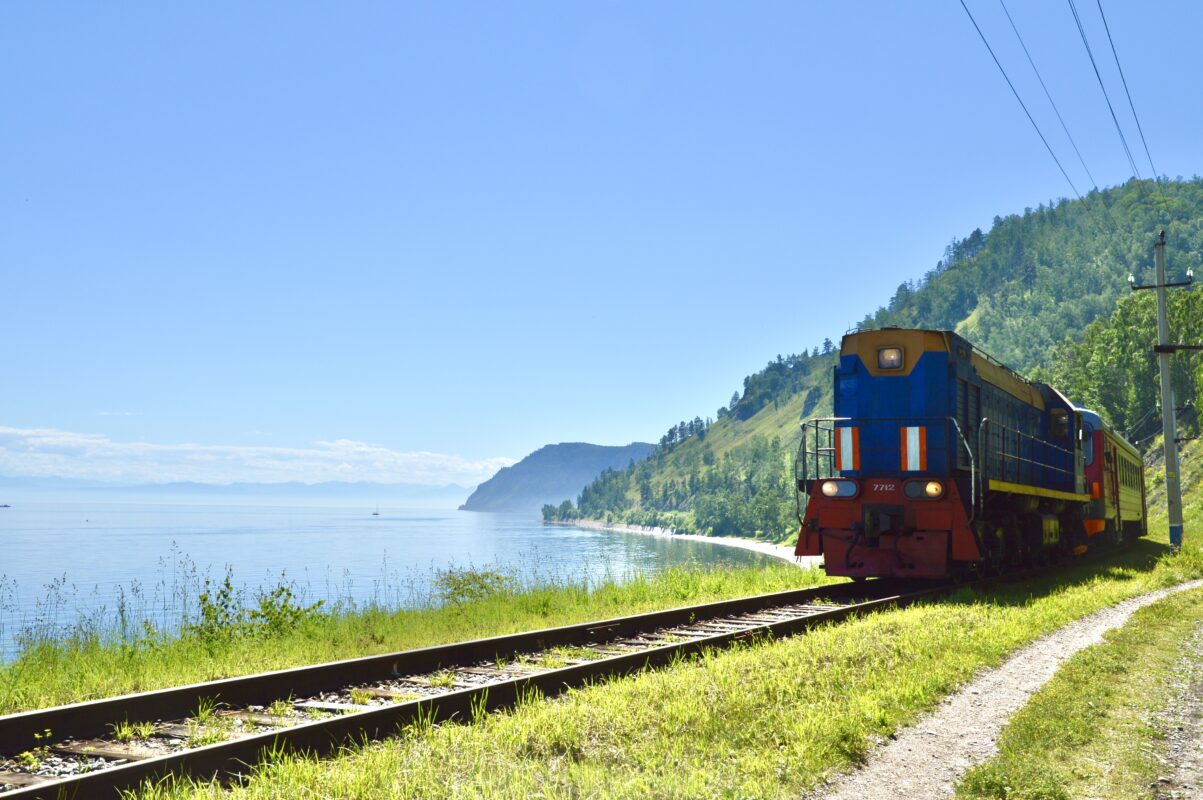
After a short stop at our day hotel near the Irkutsk railway station, our guide picked us up for the drive out to Lake Baikal. Our itinerary for the day turned out to be perfect (thanks to my travel partner!): a private boat ride across the crystal-clear waters of the lake, a hike along the old Circum-Baikal railway tracks hugging the shoreline, some gorgeous train spotting, a ferry ride back across the bay, and relishing Omul, the famous dried fish specialty of Lake Baikal.
Along the way, we stopped at a Siberian village exhibit for a glimpse into local life and culture before finally reaching the shores of the legendary lake we had dreamed of visiting. Our first stop was a gondola ride up a nearby mountain to appreciate the vastness of Lake Baikal and the beauty of its deep blue waters. From the summit, Lake Baikal stretched endlessly into the horizon, dark blue against the Siberian mountains, still carrying the coldness of the long winter.

Back at shore level, our boat was already waiting for us. Short but immersive, though not literally because the water was far too cold for that. Large water bodies have always fascinated me, perhaps a topic for another future series, and knowing we were sailing across the deepest freshwater lake in the world made the experience even more special.

The boat dropped us a couple of kilometers down the shoreline, allowing us to hike along the old railway line toward Baykal station while hugging the lakeshore. We expected the afternoon train to roll by, and it certainly did, made even better by the wonderful sight of trains curving gracefully along the shoreline.


From Baykal station, where the ferry timing is coordinated with train arrivals, we took a short ferry ride back to Listvyanka across the mouth of the Angara River. Now it was finally time to taste the local Omul fish, displayed at nearly every stall in the local market.
After a meal and a relaxed walk along the shore, we began our hour and a half drive back to Irkutsk. to board yet another train eastward toward Mongolia. Lake Baikal was behind us once more, though Siberia still has a way of leaving unfinished dreams.
Another desire remains: to someday experience the modern catamaran ferry that traverses north-south across Lake Baikal, connecting Severobaikalsk on the northern shore to the southern end of the lake while stopping at various small towns along the route. Ah, the list never ends!
A few more photographs below with descriptions:

As we take the ferry back, Port Baikal station comes into view with the steam locomotive on display and the passenger train getting ready to depart.

Soviet Railways Class L steam locomotive L-4657 (Л class), preserved as a monument to the historic railway. A classic 2-10-0 freight steam locomotive built in the postwar Soviet era of the late 1940s and 1950s.

Beautiful Irkutsk station building in soft yellow pastel wonderfully iconic of classic Russian railway architecture with wide platforms.
