
-400x300.jpeg)

Between jobs and at the tail end of the Covid-19 shutdowns, I found a unique opportunity to explore Ukraine’s railway system. Having traveled to Russia twice before, Soviet (or rather ex-Soviet) railways had long been high on my list, and there was no better place to experience them than Ukraine which is home to one of Europe’s largest rail networks, spanning over 22,000 km.
That urge brought me to Kharkiv.
Ukraine’s second-largest city lies in the country’s northeast near the Russian border. Often referred to as Ukraine’s student capital, Kharkiv is home to more than 40 universities. In recent years, because of the war and its proximity to the border, the city has also become a symbol of resilience and strength.
After landing in Kyiv earlier that day and taking a five-hour train ride east, I arrived in Kharkiv well past dark. Late-night arrivals at deserted railway stations in a foreign country carry a certain quiet unease, and in deep Soviet-era surroundings, that feeling only intensifies.
The cinematic setting heightened my discomfort almost immediately. We had arrived at the farthest platform, and the only path out led through a long, dimly lit, foul-smelling underpass where a few shadowy figures lingered silently along the walls.

On the other side, the situation offered little relief. There were no taxis in sight, and the ride-hailing apps refused to work. Then, in a distant dark corner, I spotted a lone private cab. With the help of Google Translate, I managed to negotiate the ride. The car was a clunky old Audi sedan, and the driver with his gravelly voice perfectly matching the mood, smoked one cigarette after another, three in just twenty minutes. Words do not quite capture the unease of that journey, and to this day it remains, without question, the scariest taxi ride of my life.
The hotel and the following day could not have been more different from the night I had just endured. Ironically, the very hotel where I stayed, the Kharkiv Palace Hotel, was severely damaged in a Russian missile strike on December 30, 2023, a stark reminder of how quickly the city’s story has changed.

I had less than twenty hours in Kharkiv, but I made the most of them: visiting Gorky Park, wandering the city’s broad boulevards, and most importantly, exploring its underground metro system. Soviet-era cities are known for the artistic grandeur of their metro stations, and Kharkiv is no exception. Like many subway systems of its time, the Kharkiv Metro was designed not only for transit but also as a network of bomb shelters, a role it has tragically continued to serve in recent years.
Beneath Kharkiv’s wide boulevards lies a system that feels more like a hidden underground world than public transport. Opened in 1975, the metro has expanded to more than 30 stations across three lines, stretching roughly 38 km throughout the city. Some stations plunge nearly 40 meters below the surface. Marble columns, chandeliers, and intricate mosaics transform these spaces into grand subterranean halls, each with its own distinct character.

Above ground, the city is defined by expansive boulevards, faded pastel Soviet-era buildings, and iconic landmarks such as the constructivist Derzhprom building and Freedom Square — one of the largest city squares in Europe.

Before dusk, I returned to the railway station to begin one of the longest train journeys possible within Ukraine: from Kharkiv in the northeast near the Russian border to Rakhiv in the far southwest, deep in the Carpathian Mountains near Romania.
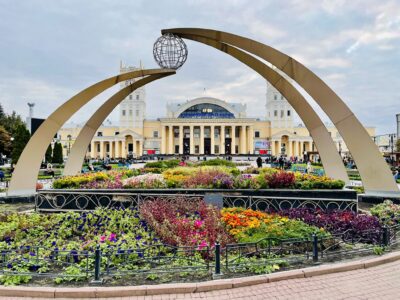
Kharkiv’s main railway station — Kharkiv Pasazhyrskyi Vokzal (Харьков-Пассажирский) — is itself a monumental example of Stalinist architecture. Its vast halls and imposing façade stand as reminders of the city’s historical role as a major rail gateway in eastern Ukraine. Even today, despite repeated attacks, the station remains operational — a symbol of resilience, much like Kharkiv itself.


